 PersianDookht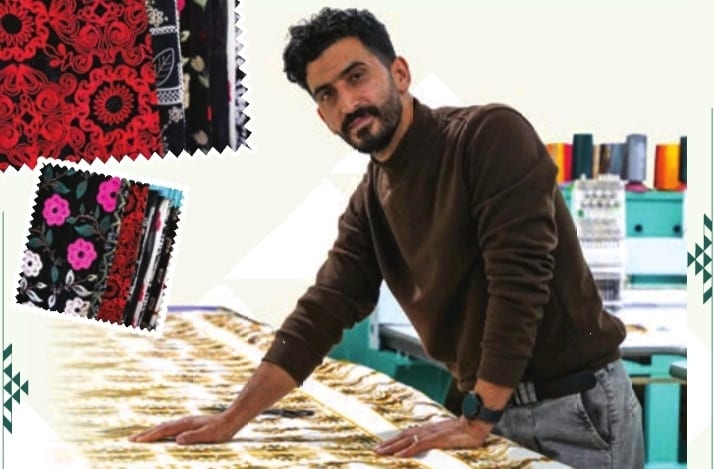
Success Woven into the Warp and Weft of Effort
Mohammad Shorideh, who once had to leave school, now exports his embroidery workshop’s products to neighboring countries.
The symphony of industrial sewing machines does not stop for a moment. The thin spools move up and down like needles. It is as if every stitch on the fabric tells a story of art and beauty. The fabrics sewn with traditional colors and patterns display a passion rooted in Iranian culture. Meanwhile, Mohammad Shorideh, the workshop manager, walks calmly and confidently among the machines and glances at his workers.
We go up the basement stairs and enter a section where several cutting stations are cutting fabrics, and another group sits behind sewing machines. In this section, there is no sound from the machines; only the sound of cutting fabric and sewing machines can be heard.
This is an industrial Baluchi embroidery workshop; a workshop full of colorful designs and patterns whose products not only have many fans but also try to keep culture and art alive. It is a place where a hardworking young man directly and indirectly turns the wheel of life and keeps hope for the future alive in his colleagues’ hearts.
I Didn’t Study Beyond Guidance School
Mohammad Agha says about his education: “I didn’t study beyond guidance school.” In those days when he was working at the sewing machine, in elementary school...
Childhood and Labor
The first hours of the workday. Mohammad Shorideh and his colleagues... He entered the labor market from childhood and was forced to leave school. Life’s hardships made him familiar with work and effort earlier than his peers.
Visits and Observations
In those days when he was working at the sewing machine, he gradually concluded that he should learn the work professionally. After military service, he decided to set up his own independent workshop and separate his work from his brother’s.
A Serious Decision for the Future
Military service was a good opportunity to think about his future and make new decisions. There, he concluded that he should pursue work professionally in the field of repairing industrial machines. Of course, he also thought about setting up an independent workshop and separating his work from his brother’s. For the first step, he bought machines under supervision, but he was still working in the same workshop.
Mr. Mohammadi says: “It was 2016 when we bought new machines. In the days when most workshops were in recession, right at the peak of inflation, when most people were in disarray, I relaunched my production workshop. That year we bought two machines. I consulted with several people. They also said it was right; the choice was on this path, and I started with people like myself.”
During this time, Shorideh became acquainted through his friends with one of the university professors in the field of traditional sewing. His mentor taught Baluchi handicrafts. He had said: “I had many ideas; we talked for several sessions and decided to start the work.”
Mohammad, using the basic skills of that professor, learned designs from others and started his work. In 2018, the capital he needed to launch his workshop was 20 million tomans, but his total savings were 15 million. With a lot of debt, he finally started. In the first month, he made a total profit of 40,000 tomans. Meanwhile, he had to pay workers’ salaries. The work was new, and he and his colleagues did not yet have much speed; therefore, orders were not delivered on time, and he had to compensate employers for delays. In the first few months, he had a lot of anxiety. Those around him had told him not to start in this situation. But he did not accept failure. His efforts paid off, and after a few months, the work became profitable.
Starting with Full Strength
Shorideh married in 2018. His wife accompanied him on this path. To become more familiar with traditional Baluchi embroidery, he traveled to Sistan and Baluchestan every month. At first, he went to the markets of this province to copy designs, but in later years he traveled to learn and teach.
According to Mohammad Agha, the world of Baluchi and traditional embroidery in our country is so vast that even if you spend years learning, it is still not enough. During these comings and goings, he became more interested in Baluchi culture and tradition and tried to increase his knowledge and incorporate it into his sewing. He picks up a fabric near him and explains the types of flowers and geometric embroidery sewn on traditional fabrics: “This embroidery is one of the well-known styles of Baluchi women’s embroidery; an embroidery known for mirror work, geometric designs, and warm colors.”
The Story-Filled World of Baluchi Embroidery
Baluchi women spend hours making beautiful clothes. Their products are used not only for daily wear but also as valuable economic goods. Now that I look at the fabrics, I know that herbal and floral patterns include small and large flowers, stems, leaves, animal motifs, and birds.
Shorideh says: “In general, it can be said that each region has its own signature in motifs; for example, Baluchis work more geometrically and angularly, Khorasanis and Kermanis have moved toward flowers, plants, and nature, and southerners like Bandar Abbas do more mirror work, and people in the sun and stars...”
Embroidery is not just a manual skill; it is a cultural heritage that shows the creativity, patience, and artistic taste of Iranian women. By looking at embroidered clothes, one can talk about their roots and emotional identity.
One of Mr. Shorideh’s goals is to have a specialized team so that he can research the designs, stories, and legends behind this traditional embroidery, write them down, and publish them.
Challenges of Production Work
Many of those who have a hand in traditional sewing oppose industrial sewing. Shorideh is aware of this issue. But he believes handmade sewing is very expensive, and preparing several sets of clothes per year is not cost-effective for enthusiasts. In his words, he emphasizes: “Industrial machines cannot replace the handiwork of Baluchi women, but industrial sewing helps these needed fabrics reach the buyer at a lower price.”
Mirror Work on These Embroideries
Mirror work on these embroideries is a new task he is doing these days in his workshop.
During this time, he has gone through many challenges; from buying up-to-date and specialized machines for sewing designs to finding a sales market. One of the main challenges has been this: first, one must learn the sales market. In his opinion, a good seller can also be a good producer.
This producer says: “Our fabrics are mainly sent to the markets of Sistan and Baluchestan, Mashhad, Kerman, Mazandaran, Shiraz, and any city that has Baluchis. They are also sent to Afghanistan and Pakistan.” This producer has many ideas for promoting traditional embroidery. He continues: “I want to expand my work so much that next year we become the hub of traditional sewing in the east of the country.”
Along with Hardships
Fatemeh Mohammadzadeh, Mr. Shorideh’s wife, throughout the time when workers and sewers are present... We talk. She is present among the cutters and sewers and is the foundation of this activity. Sometimes she glances at her husband’s shelves/workspace. She became familiar with traditional Baluchi embroidery since marriage. She says: “From the beginning of the work until now, I have never seen any shortcoming from myself or my husband.” She says: “We have gone through hard days. During the Corona period, we produced masks for a limited time. Production workshops faced recession. Still, we never abandoned the work.”
Stories tell of lack of support from banks, producers, and support organizations. But according to Fatemeh, none of these institutions have so far seriously supported handicraft producers.
Teamwork Spirit
One of the colleagues says: “Around Thursday night at 10 o’clock, the workshop... the colorful women... I care about this... I want to skip sleep and rest... truly this new work... our work and production... is heading toward the future... I say with traditional sewing it’s not just money... many of my friends... if we... with traditional sewing... bread... we help the family economy.”
The spirit of teamwork in this workshop has made everyone work together with motivation. Traditional sewing for them is not only a source of income but also a cultural heritage that helps families’ economies.
We Are One Family
Leila Pourhosseini has been cooperating with Shorideh’s workshop for nearly twelve years. She says: “Here we are like family. I feel good. Workers here cooperate and are friendly. Some workers have been in this workshop for years. It started this way: with Shorideh’s training, setup, and... we reached here. Now after ten years of work, although we have many hardships, we are satisfied. Some of the good features of the workshop are that workers can be together. The atmosphere is warm and friendly. This work has made us one family, and we can help each other.”
Source: Shahrara Mahalleh Supplement (Districts 7 and 8 of Mashhad), Issue 643
Publication Date: Tuesday, 9 Dey 1404 (December 30, 2025)
News Code: 13813
Comments
No comments yet.